


Steps For Determining Correct Load Limit
1. Locate the statement "The combined weight of occupants and cargo should never exceed XXX kg or XXX lbs.'' on your vehicle's placard.
2. Determine the combined weight of the driver and passengers that will be riding in your vehicle.
3. Subtract the combined weight of the driver and passengers from XXX kg or XXX lbs.
4. The resulting figure equals the available amount of cargo and luggage load capacity. For example, if the "XXX" amount equals 1400 lbs. and there will be five 150 lb passengers in your vehicle, the amount of available cargo and luggage load capacity is 650 lbs.
(1400-750 (5 x 150) = 650 lbs.) 5. Determine the combined weight of luggage and cargo being loaded on the vehicle. That weight may not safely exceed the available cargo and luggage load capacity calculated in Step 4.
6. If your vehicle will be towing a trailer, load from your trailer will be transferred to your vehicle. Consult this manual to determine how this reduces the available cargo and luggage load capacity of your vehicle.
CAUTION
We do not recommend using this vehicle for trailer towing.
Example 1
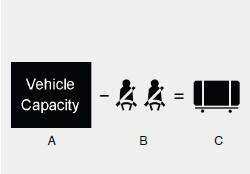
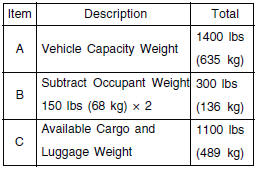
Example 2
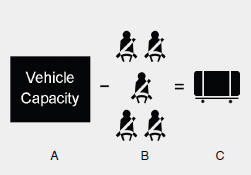
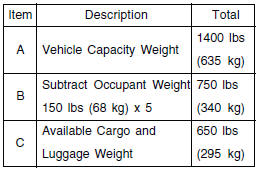
Example 3
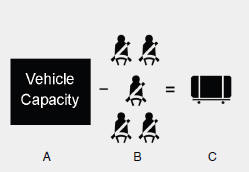
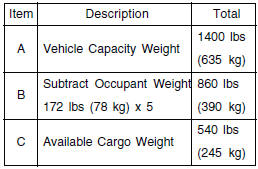
Refer to your vehicle’s tire and loading information label for specific information about your vehicle’s capacity weight and seating positions. The combined weight of the driver, passengers and cargo should never exceed your vehicle’s capacity weight.
See also:
Exterior
Roughly the same size as Honda’s first-generation CR-V, the Santa Fe is 177.2
inches long overall and close to 66 inches tall. It rides on a 103.1-inch
wheelbase. Ford’s Escape has the same wheelb ...
Map lamp
Push the lens to turn the map lamp on or off. This light produces a spot beam
for convenient use as a map lamp at night or as a personal lamp for the driver and
the front passenger.
• DOOR : In ...
Vehicle certification label
The vehicle certification label attached on the driver’s side center pillar contains
the vehicle identification number (VIN). ...