


Headlight aiming adjustment
Before performing aiming adjustment, make sure of the following.
1. Keep all tires inflated to the correct pressure.
2. Place the vehicle on level ground and press the front bumper & rear bumper down several times.
Place vehicle at a distance of 118 in. (3m) from the test wall.
3. See that the vehicle is unloaded (except for full levels of coolant, engine oil and fuel, and spare tire, jack, and tools). Have the driver or equivalent weight placed in driver's seat.
4. Clean the head light lenses and turn on the headlights (Low beam).
5. Open the hood.
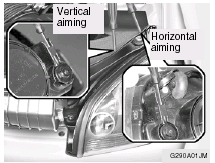
6. Draw a vertical line (through the center of each headlight beam pattern) and a horizontal line (through the center of each headlight beam pattern) on the aiming screen.
And then, draw a parallel line at 0.8 in. (21 mm) under the horizontal line.
7. Adjust each cut-off line of the low beam to the parallel line with a phillips screwdriver - VERTICAL AIMING.
WARNING:
Never attempt to adjust the horizontal alignment
of your headlights. Horizontal aiming
must be adjusted by an authorized Hyundai
dealer to avoid incorrect alignment that will
reduce the effectiveness of your headlights.
Adjustment After Headlight Assembly Replacement
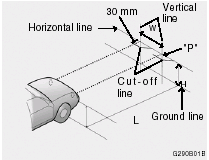
If the vehicle has had front body repair and the headlight assembly has been replaced, the headlight aiming should be checked using an aiming chart as shown in the illustration. Turn on the headlight switch. (Low Beam Position)
1. Adjust headlights so that main axis of light is parallel to center line of the body and is aligned with point "P" shown in the illustration.
2. Dotted lines in the illustration show the center of headlights.
SPECIFICATION:
"H";
Horizontal center line of headlights from
ground: 35.6 in.(904 mm).
"W";
Distance between each headlight center:
53.4 in.(1,356 mm).
"L";
Distance between the headlights and the
wall that the lights are tested against:
118 in. (3,000 mm).
See also:
Driving in the rain
Rain and wet roads can make driving dangerous, especially if you’re not prepared
for the slick pavement. Here are a few things to consider when driving in the rain:
• A heavy rainfall will make it ...
Use High Quality Ethylene Glycol Coolant
Your Hyundai is delivered with high quality ethylene glycol coolant in the cooling
system. It is the only type of coolant that should be used because it helps prevent
corrosion in the cooling syst ...
Recommended SAE viscosity number
CAUTION
Always be sure to clean the area around any filler plug, drain plug, or dipstick
before checking or draining any lubricant. This is especially important in dusty
or sandy areas and when t ...